
Best Well Water Arsenic Water Filter for Safety in 2025
Find the best well water arsenic water filter systems in 2025. Ensure safe, clean drinking water for your family with proven filtration solutions.

Affiliate disclosure: Some links on this page are affiliate links. If you click an affiliate link and make a purchase, I may earn a small commission at no extra cost to you. I only recommend products I believe are useful to readers.
Arsenic can enter well water naturally from surrounding rock and soil, and its form matters to filtration. A system that targets arsenic V is not automatically a match for arsenic III, so the water test has to identify more than a total concentration.
Long-term exposure to arsenic in drinking water can cause serious health problems. Effective filtration is essential for well water users.
Arsenic water filters use different technologies to remove this contaminant from your water supply. The most effective systems combine multiple filtration methods, such as reverse osmosis, activated alumina, or iron-based media, to reduce arsenic levels below the EPA’s maximum limit of 10 parts per billion.
Point-of-use filters that treat water at a single tap and whole-house systems that filter all incoming water are both available options. When choosing an arsenic filter, the most important factor is certification for arsenic removal by independent testing organizations like NSF International or the Water Quality Association.
You should also consider your water’s arsenic levels through testing. The filter’s capacity and flow rate, as well as ongoing maintenance costs for replacement cartridges, are important factors.
Best Well Water Arsenic Filters
The picks below are organized using published specifications, stated performance claims, maintenance demands, and fit for different household use cases. I prioritized certified arsenic-reduction methods, filter capacity, and installation fit.
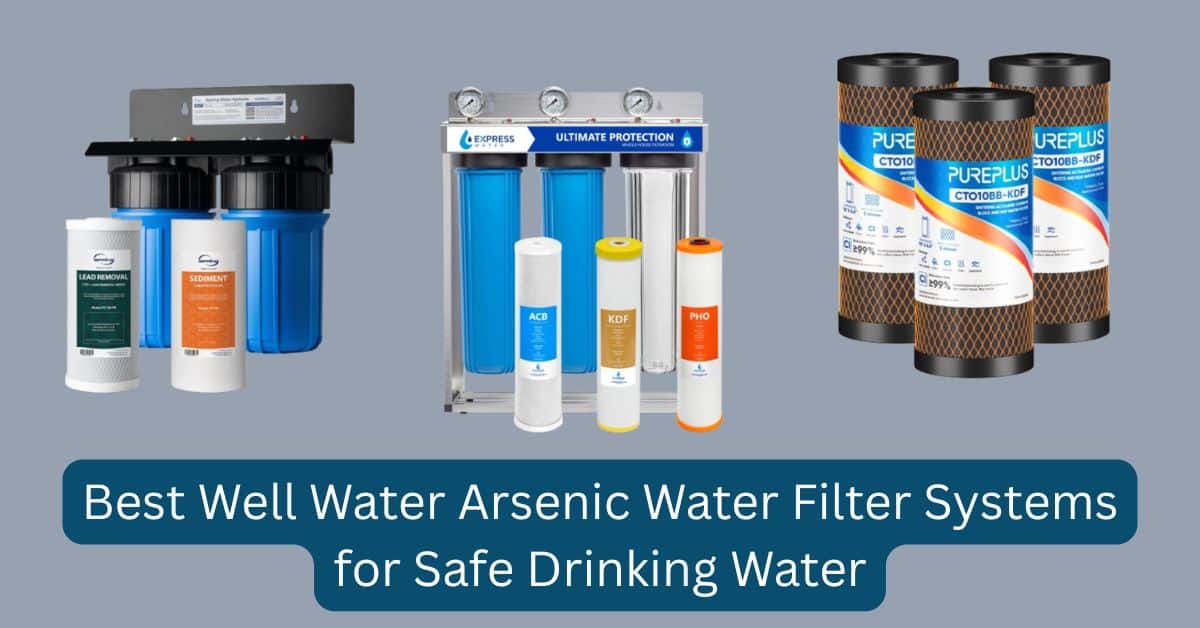
iSpring Heavy Metal Filter System

Best for families dealing with arsenic and heavy metal contamination because it delivers reliable filtration with good flow rates.
Key specs: 3-stage whole-house system (WGB32B-CPB); 100,000-gallon capacity / up to 12 months; flow up to 15 GPM; first stage 5-micron sediment; 20” × 4.5” cartridges; 1” NPT ports; SGS-tested to reduce up to 99% lead (iSpring – WGB32B-CPB Whole House Water Filter System)
Pros
- Removes arsenic and multiple heavy metals effectively through advanced media
- Maintains strong water pressure at 15 GPM for whole house use
- Easy installation process with clear instructions and video support
Cons
- Large size requires adequate space for mounting all three filter housings
- Filter replacement costs add up over time with three separate cartridges
- Initial setup investment is higher than basic sediment filters
Express Water Whole House System

Best for homeowners who want comprehensive arsenic removal throughout their entire house and don’t mind the higher upfront cost.
Key specs: 3-stage; rated for 100,000 gallons; flow 0.25 gal/s at 45-80 PSI (about 15 GPM); stainless-steel stand; activated carbon, KDF, and polyphosphate media; filter changes every 6-12 months (Express Water – Ultimate Protection Whole House System)
Pros
- Removes arsenic and heavy metals from every faucet in your home
- Built with heavy-duty stainless steel components that last
- Easy filter changes with pressure release buttons and gauges
Cons
- Takes up significant space and weighs 63 pounds
- Filter replacements every 6-12 months add ongoing costs
- Installation requires plumbing knowledge or professional help
Crystal Quest Arsenic Filter

Best for buyers who want a cartridge-based arsenic filter at a lower entry cost.
Key specs: arsenic-selective resin cartridge (CQE-RC-04008); 2-7/8” × 9-3/4” cartridge; rated for 1,000 gallons; flow rate 0.5 GPM; operating pressure 20-60 psi (Crystal Quest – Arsenic Removal Filter Cartridge)
Pros
- Removes both types of arsenic effectively from well water
- Works for up to 1,000 gallons before needing replacement
- Fits standard filter housings without any modifications
Cons
- Flow rate drops to only 0.5 gallons per minute during use
- Cartridge costs add up over time with regular replacements
- Installation requires an existing compatible filter housing system
iSpring FC25B-PB Heavy Metal Filter

Best for homes that need broad heavy-metal reduction alongside arsenic treatment.
Key specs: FC25B-PB 4.5” × 20” cartridge; rated up to 100,000 gallons / 12 months; SGS-tested to reduce up to 99% lead; arsenic/cadmium/chlorine reduction (iSpring – FC25B-PB SGS-Tested 4.5” x 20” Filter)
Pros
- Removes up to 99% of arsenic and lead with SGS-tested performance
- Lasts up to 12 months or 100,000 gallons before needing replacement
- Fits standard filter housings without requiring special equipment
Cons
- Does not reduce total dissolved solids like reverse osmosis systems
- May require professional installation for optimal performance
- Higher upfront cost compared to basic carbon filters
AdEdge Inline Arsenic Filter

Best for adding arsenic removal to existing water systems.
Key specs: AD2X10C inline cartridge with 1/4” quick-connect fittings; the listing states 100% Bayoxide E33 media (AdEdge listing on Amazon); uses Bayoxide E33 crystalline iron-oxide arsenic-adsorption media, per AdEdge’s technical brochure (AdEdge – Bayoxide E33 Media Performance Results); the listing states a 10-inch cartridge length (AdEdge listing on Amazon)
Pros
- Removes both types of arsenic without needing extra equipment
- Connects easily to most current water filter setups
- Takes up very little space at just 10 inches long
Cons
- Filter cartridges need frequent replacement which gets expensive
- Water flow slows down noticeably when filter starts getting full
- Installation requires some basic plumbing skills with quick-connect fittings
PRO+AQUA Heavy Duty Well Water Filter

Best for larger households.
Key specs: backwashing whole-house filter (PRO-WELL-1E); max flow 10 GPM; 83 lb; 2-year standard warranty, extendable to 4 years with registration (PRO+AQUA – PRO-WELL-1E Whole House Well Water Filtration System)
Pros
- Digital display makes programming backwash cycles simple and monitoring system status straightforward
- Handles high contaminant loads effectively including arsenic, heavy metals, and iron from well water
- Built with commercial-grade components in the USA that feel sturdy and durable
Cons
- Takes up significant floor space at nearly 5 feet tall in utility areas
- Some users report backwash function failures that require manufacturer support
- Higher upfront cost compared to basic carbon filtration systems
iSpring WGB21B-CPB Arsenic Filter

Best for well water owners who need reliable arsenic removal with the convenience of a pre-assembled design.
Key specs: 2-stage (WGB21B-CPB); 50,000-gallon capacity / about 1 year; first stage 5-micron sediment; listing states it reduces arsenic, cadmium, mercury, and up to 99% lead; 1” ports (iSpring WGB21B-CPB listing on Amazon)
Pros
- Installation takes minimal time thanks to the pre-mounted bracket and included tools.
- Filters last up to 50,000 gallons or a full year for most families.
- Lead removal reaches 99% effectiveness while also handling arsenic and mercury.
Cons
- Large 16-inch footprint requires significant wall space for mounting.
- Two-stage design means buying replacement filters for both housings.
- Water pressure drops slightly during peak usage times.
PUREPLUS Coconut Shell Carbon KDF Filter

Best for homeowners dealing with arsenic and heavy metals in their well water because it combines activated carbon with KDF media for effective removal.
Key specs: 5-micron 10” × 4.5” carbon + KDF cartridge (CTO10BB-KDF); manufacturer states it removes heavy metals including lead, mercury, and arsenic; sold as a 3-pack (PUREPLUS – 5 Micron Coconut Shell Activated Carbon and KDF Water Filter); 90-day limited manufacturer warranty (PUREPLUS – Warranty Policy)
Pros
- Removes multiple heavy metals including arsenic, lead, and mercury through dual-action filtration.
- Works well to eliminate chlorine taste and musty water odors.
- Compatible with many standard 10-inch filter housings and systems.
Cons
- Some filters may fail earlier than expected based on water conditions.
- Replacement costs can add up over time.
- Filter life depends heavily on your specific water hardness and quality.
Aquasana Whole House Well Water System

Best for well water homes that want whole-house filtration, UV, and salt-free scale control in one system.
Key specs: rated for 500,000 gallons; flow up to 14.7 GPM; KDF (copper-zinc) + carbon media with UV; salt-free scale prevention; 5-year filter life backed by a 5-year limited warranty; 57” × 11” tank dimensions (Aquasana – Rhino Well Water with UV) (Aquasana listing on Amazon)
Pros
- Multiple filtration stages tackle bacteria, viruses, and scale buildup effectively.
- Salt-free water conditioning preserves healthy minerals while preventing pipe damage.
- Five-year filter life reduces long-term maintenance costs significantly.
Cons
- Installation requires professional help due to system complexity and weight.
- High initial investment makes it costly for budget-conscious buyers.
- Large size demands substantial space in utility areas.
iSpring FC15B-PB Heavy Metal Filter

Best for standard 10-inch housings.
Key specs: FC15B-PB 4.5” × 10” cartridge; rated up to 50,000 gallons / 12 months; listing states MetSorb media removes up to 99% lead plus arsenic III/V, mercury, cadmium; fits 10” housings (iSpring FC15B-PB listing on Amazon)
Pros
- Removes up to 99% of arsenic, lead, and other heavy metals effectively.
- Fits standard filter housings without compatibility issues.
- Long filter life of 12 months or 50,000 gallons reduces maintenance.
Cons
- Does not reduce total dissolved solids like reverse osmosis systems.
- Only works with specific housing sizes and may need system upgrades.
- Limited customer reviews make long-term performance difficult to assess.
AFWFilters Activated Alumina Cartridge

Best for whole house systems.
Key specs: 4.5” × 20” activated-alumina cartridge; reduces fluoride and arsenic; 6.35 kg (14 lb) cartridge (AFWFilters listing on Amazon)
Pros
- Removes both arsenic and fluoride effectively with synthetic aluminum oxide media.
- Works throughout your entire home when installed in whole house systems.
- Specially designed for well water contamination issues.
Cons
- Only works well when water pH stays between 5 and 7, which many wells exceed.
- Weighs 14 pounds when loaded, making installation and replacement physically demanding.
- Limited availability and higher cost compared to standard carbon filters.
PUREPLUS KDF/GAC Whole House Filter

Best for homeowners who need reliable arsenic removal with the added benefit of comprehensive water treatment at an affordable price point.
Key specs: 5-micron 20” × 4.5” KDF/coconut-shell GAC cartridge (RFN20BB-CKDF) (PUREPLUS – 5 Micron Whole House Granular Activated Carbon and KDF Water Filter); manufacturer states it reduces heavy metals including lead, mercury, and arsenic, plus chlorine (same source); covered by PUREPLUS’s 90-day limited manufacturer warranty (PUREPLUS – Warranty Policy)
Pros
- Dual-action filtration tackles arsenic and other heavy metals while improving taste and odor.
- Installation process is simple and works with most standard whole house systems.
- Filter lasts longer than basic carbon-only options due to the KDF media blend.
Cons
- Large 20-inch size won’t fit in compact filter housings.
- Performance drops noticeably when water has high sediment levels.
- Replacement costs add up quickly for households with heavy water usage.
Buying Guide
Arsenic occurs in well water as arsenic III or arsenic V, and the two need different media to catch — only the iSpring FC15B-PB cartridge below specifies MetSorb media rated for “arsenic III/V” directly, while the other adsorptive and resin cartridges on this page don’t state which form they target. That distinction matters more than brand size: whole-house resin and iron-oxide systems, like the iSpring and AdEdge picks, treat every tap but need replacing once their adsorption media runs out, while a point-of-use cartridge like the Crystal Quest unit costs less upfront and protects only your drinking water, with a cartridge rated for just 1,000 gallons before it needs swapping. Test your water for arsenic species and pH before buying — the activated-alumina cartridge on this page is only rated to work between pH 5 and 7.
Filtration Technology
Reverse osmosis uses a membrane at the drinking tap, while activated alumina and iron-based media adsorb arsenic as water passes through a cartridge or tank. Ion exchange is another option on the page; a basic carbon filter is not presented as an arsenic treatment.
Certification and Testing
Read the exact arsenic-reduction claim attached to an NSF certification, including test conditions and model number. The performance figures discussed here reach at least 95% reduction, but that percentage is meaningful only when the certified water chemistry matches the well.
Flow Rate and Capacity
A whole-house resin or iron-oxide tank treats every tap, while a point-of-use cartridge protects only the drinking-water outlet. The Crystal Quest example is rated for 1,000 gallons, making capacity and replacement frequency especially important for an under-sink choice.
Maintenance Requirements
Use the manufacturer’s capacity and the well’s arsenic concentration to plan replacement rather than relying on appearance or taste. The cartridge schedules discussed here commonly fall in the 6-12 month range, so price the replacement media before comparing initial system cost.
Installation Needs
An under-sink cartridge needs cabinet clearance and a dedicated drinking-water connection; a whole-house media tank needs more floor area, a main-line plumbing change, and service access. Confirm those constraints before treating the smaller purchase price as the easier installation.
Frequently Asked Questions
Arsenic removal systems use specific filtration methods like reverse osmosis and specialized media. Filter performance depends on removal rates and certified testing results.
How should arsenic species and pH determine the filter media?
Start with a lab result that distinguishes arsenic III from arsenic V and records pH. The iSpring FC15B-PB on this page states treatment for both forms, while the activated-alumina cartridge is rated only for water between pH 5 and 7.
Iron-based media filters also work well for arsenic removal. These filters contain materials like granular ferric oxide that attract and trap arsenic.
Activated alumina filters can address both arsenic III and arsenic V. Systems that combine multiple filtration stages are often a better fit when water chemistry is more complex.
Distillation units can remove arsenic but use more energy than other methods. Ion exchange systems work best when paired with other filtration technologies.
How do you evaluate the performance of arsenic water filters?
NSF certification is one of the first things to check when choosing arsenic filters. NSF Standard 53 tests filters for arsenic reduction and confirms removal rates.
Check the filter’s arsenic removal percentage in lab test results. Good filters remove at least 95% of arsenic from water samples.
Flow rate matters for daily water use needs. Most whole-house systems process 5-15 gallons per minute without losing filtration quality.
Test your water before and after installation to verify performance. Annual follow-up testing helps confirm the system is still reducing arsenic as expected.
What are the differences between point-of-use and whole-house arsenic filtration systems?
Point-of-use filters treat water at one location like a kitchen sink. These systems cost less and are easier to install than whole-house units.
Whole-house systems filter all water entering your home. They protect appliances and provide filtered water to every faucet and fixture.
Point-of-use systems typically use reverse osmosis technology. Whole-house systems often combine multiple filtration methods for better coverage.
Maintenance differs between the two types of systems. Point-of-use filters need replacement every 6-12 months while whole-house systems last 3-5 years.
Can you remove arsenic from water without using chemicals?
Physical filtration removes arsenic without adding chemicals to your water. Reverse osmosis uses pressure to push water through membranes that block arsenic.
Activated alumina and iron-based media trap arsenic through adsorption. These materials attract arsenic particles without chemical reactions.
Distillation boils water and collects clean steam in a separate container. This method removes arsenic without any chemical additives.
Some systems use ion exchange resins that swap arsenic for safe minerals. This is considered a non-chemical method since it only exchanges existing particles.
What should I consider when choosing a whole-house arsenic water filter?
Calculate your home’s water usage to determine the right system size. Most families need systems that handle 10-15 gallons per minute.
Check your current arsenic levels with professional water testing. Higher arsenic concentrations may need more powerful filtration systems.
Consider installation space and plumbing requirements before buying. Some systems need electrical connections and drain lines for backwashing.
Look at long-term costs including filter replacements and maintenance. Compare 5-year operating costs between different systems.
How often should arsenic water filters be replaced or serviced for optimal performance?
Point-of-use reverse osmosis filters need replacement every 6-12 months. Pre-filters in these systems may need changing every 3-6 months.
Whole-house system media typically lasts 3-5 years with proper maintenance. Iron-based filters may need backwashing every 1-2 weeks.
Professional water testing is recommended every 6-12 months to check filter performance.
System maintenance schedules vary by manufacturer and water conditions. Hard water or high sediment levels may require more frequent filter changes.

Thomas Peterson
Owner WSA
About the Author
Latest Posts
Born and raised in Nanaimo on Vancouver Island. Thomas gained a deep appreciation for the importance of clean, reliable water. With over 15 years of experience working with water treatment systems, Thomas has become a trusted expert in helping local homeowners and businesses resolve the unique challenges of well water across the Island.
From hard water and iron buildup to low water pressure and sediment issues, Thomas takes a practical, no-nonsense approach to solving water problems. Whether it’s installing filtration systems or troubleshooting well pump issues, Thomas focuses on long-lasting solutions that help people get the clean, safe water they need.
As a proud local professional, Thomas is dedicated to serving his community with honesty, quality service, and expert advice tailored to the water conditions of Vancouver Island.
Areas of Expertise: Well Service, Well Pumps, Water Filtration Systems
- Clack Water Softener Alternatives: Top Systems for Hard Water Treatment in 2025 November 8, 2025
- Best Well Water Test Kit Options for Safe Home Water Testing in 2025 November 5, 2025
- Best Well Water TDS Meter for Accurate Home Testing in 2025 November 1, 2025
- Best Well Water Sediment Filter Systems for Clean Home Water in 2025 October 29, 2025
- Best Well Water Saltless Water Softener Systems for 2025 October 26, 2025
Facebook Twitter LinkedIn Instagram Reddit
Fact Checked & Editorial Guidelines
The Fact Checking Process
I prioritize accuracy and integrity in my content. Here’s how I maintain high standards:
- Expert Review: All articles are reviewed by subject matter experts.
- Source Validation: Information is backed by credible, up-to-date sources.
- Transparency: I clearly cite references and disclose potential conflicts.
Your trust is important. Learn more about my fact checking process and editorial policy.
Reviewed by: Subject Matter Experts
The Review Board
The content is carefully reviewed by experienced professionals to ensure accuracy and relevance.
- Qualified Experts: Each article is assessed by specialists with field-specific knowledge.
- Up-to-date Insights: I incorporate the latest research, trends, and standards.
- Commitment to Quality: Reviewers ensure clarity, correctness, and completeness.
Look for the expert-reviewed label to read content you can trust.