
Best Well Water TDS Meter – Test Water Quality
Check your water’s quality easily with the Best Well Water TDS Meter. Monitor total dissolved solids for safe drinking water.

Affiliate disclosure: Some links on this page are affiliate links. If you click an affiliate link and make a purchase, I may earn a small commission at no extra cost to you. I only recommend products I believe are useful to readers.
A TDS meter turns electrical conductivity into one number for everything dissolved in well water. It is useful for spotting a change from an established baseline, but it cannot tell whether that change came from calcium, lead, salt, or another dissolved substance.
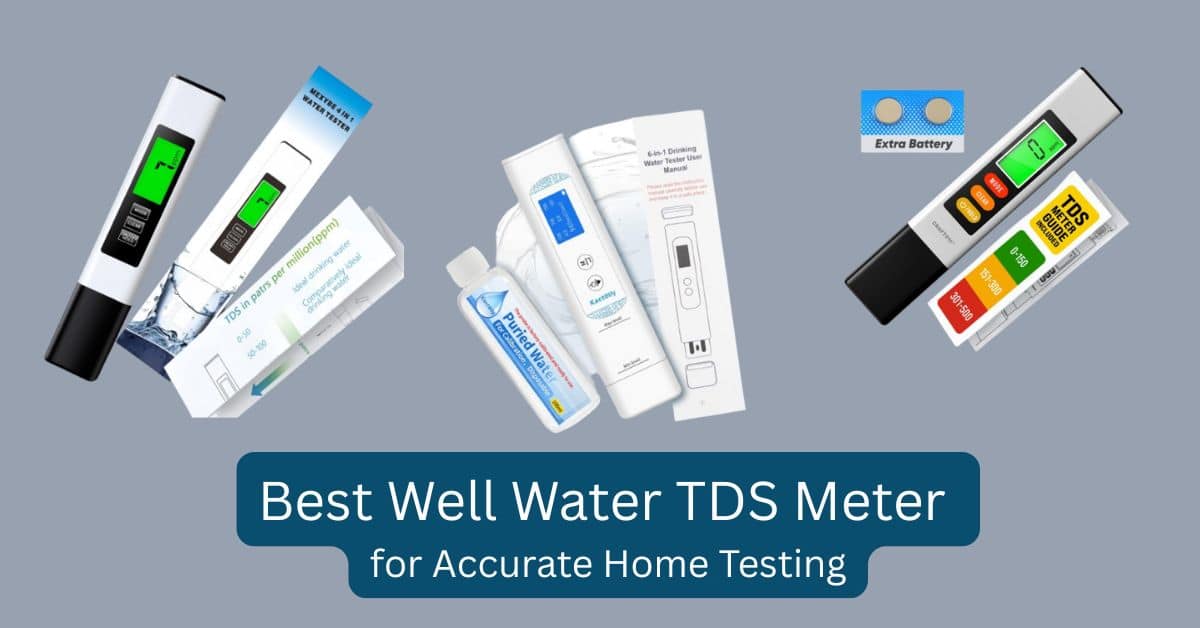
Total dissolved solids, or TDS, measure the amount of minerals, salts, and metals dissolved in water. A TDS meter helps homeowners quickly test their well water to understand what they’re drinking and using in their homes.
TDS meters provide an easy way to monitor well water quality and determine if additional filtration or treatment is needed. These digital devices work by measuring electrical conductivity in water, since dissolved solids conduct electricity.
Higher TDS readings typically indicate more minerals present, though the meter cannot identify specific contaminants. Most well water has TDS levels between 100-500 parts per million, but levels can vary greatly depending on local geology and seasonal changes.
The key factors to consider when choosing a TDS meter include accuracy range, calibration features, and durability. Look for meters that measure from 0 to at least 1000 ppm for well water testing.
Temperature compensation helps ensure accurate readings in different conditions. A waterproof or water-resistant design protects the device from spills and moisture during testing.
Best Well Water TDS Meters
Below is my full list of the best well water TDS meters. I compared published specifications, measurement features, and stated performance details to help match each option to the right use case.
MEXYBE 4-in-1 TDS Meter

Best for homeowners who want a straightforward TDS meter with a large display and multiple readings in one device.
Key specs: 4-in-1 TDS/EC/temperature meter; range 0-9999 ppm; auto-off after 2 minutes; uses 2× LR44 batteries (included) (MEXYBE 4-in-1 TDS Meter listing, Amazon)
Pros
- Large backlit screen makes readings clear even in dim conditions
- Tests four different water qualities in one compact device
- Auto-shutoff feature saves battery life during extended use
Cons
- Takes a moment to stabilize when first placed in water
- Protective cap feels slightly loose after repeated use
- Manual could provide clearer calibration instructions
HoneForest TDS Water Tester

Best for well water monitoring at a budget-friendly price.
Key specs: 3-in-1 TDS/EC/temperature meter; TDS range 0-9990 ppm; auto-off after 2 minutes of inactivity; 6.29” × 1.14” × 0.59” (HoneForest TDS Water Tester listing, Amazon)
Pros
- Fast results with readings that stabilize and lock automatically within seconds
- Three measurements in one device – TDS, conductivity, and temperature
- Backlit screen makes readings easy to see in dim conditions
Cons
- Lightweight plastic construction feels less durable than metal alternatives
- Battery compartment can be tricky to access for replacements
- Auto-shutoff feature sometimes activates too quickly during extended testing
Craft911 4-in-1 TDS Meter

Best for well water testing because it delivers consistent readings and measures multiple water quality factors in one device.
Key specs: digital TDS/EC meter; range 0-9999 ppm; 3-year warranty; 90-day money-back guarantee (Craft911 4-in-1 TDS Meter listing, Amazon)
Pros
- Takes readings instantly when dipped in water with clear, easy-to-read results
- Measures TDS, conductivity, and temperature all at once instead of needing separate tools
- Backlit screen is easier to read in dim conditions like basements or well houses
Cons
- Build quality feels basic for the price compared to professional-grade meters
- Auto-off function shuts down after just 2 minutes which can be annoying during testing
- Limited usefulness for most homeowners who only test water occasionally
Pmlilb TDS Water Tester

Best for basic well water testing due to its simple operation and fast readings.
Key specs: digital TDS meter; range 0-9990 ppm; auto-calibrates in 1-3 seconds; auto-off after 5 minutes of inactivity (Pmlilb TDS Water Tester listing, Amazon)
Pros
- Quick calibration happens in just 1-3 seconds without any setup
- Large LCD screen makes readings easy to see in different lighting
- Lightweight design fits easily in a pocket for testing anywhere
Cons
- No water quality scale included to interpret TDS readings
- Some units may arrive defective based on buyer reports
- Readings can be inconsistent with repeated measurements
VARIFY Complete 4-in-1 TDS Meter

Best for well water testing because it delivers fast readings and comes with helpful guides to understand your readings.
Key specs: 4-in-1 TDS/EC/temperature meter; package dimensions 7.48” × 1.97” × 0.83”; item weight 2.11 oz (VARIFY Complete 4-in-1 TDS Meter listing, Amazon)
Pros
- Lightning-fast 3-second readings make testing multiple water sources quick and easy
- Titanium alloy probe is built for repeated testing
- Complete kit includes everything needed with extra batteries and interpretation guide
Cons
- Small display might be hard to read in bright outdoor lighting conditions
- Auto-off feature sometimes shuts down too quickly during extended testing sessions
- Limited to TDS and temperature readings without pH or other water quality parameters
Hofun 3-in-1 Digital TDS Meter

Best for well water testing because it delivers accurate readings quickly and handles multiple water testing needs at a reasonable price.
Key specs: 3-in-1 TDS/EC/temperature meter; range 0-9990 ppm; accuracy ±2% F.S.; 6.37” × 1.14” × 0.59” (Hofun 3-in-1 Digital TDS Meter listing, Amazon)
Pros
- Large backlit display makes readings easy to see in dim conditions
- Titanium probe provides reliable measurements across a wide range
- Auto-shutoff feature saves battery life during regular use
Cons
- Probe requires careful cleaning to maintain accuracy over time
- Plastic construction feels less durable than higher-end models
- Temperature readings can lag behind actual water temperature changes
Kactoily 6-in-1 Water Tester

Best for well water testing.
Key specs: 6-in-1 lab-grade tester (TOC/COD/EC/UV275/temperature/TDS); 7” × 2” × 2”; requires 2 AAA batteries (not included) (Kactoily 6-in-1 Water Tester listing, Amazon)
Pros
- Tests six different water quality factors including TDS, temperature, and organic pollutants
- Simple one-button calibration system that works with distilled water
- Color-coded display makes results easy to understand at a glance
Cons
- May stop calibrating after the warranty period ends
- Requires frequent recalibration for most accurate readings
- Customer support can be difficult to reach when problems arise
MAROJAP 4-in-1 TDS Water Tester

Best for well water monitoring with its accurate readings and helpful safety warnings.
Key specs: 4-in-1 TDS/EC/temperature meter; 0-9990 ppm range; accuracy ±2%; resolution up to 0.02 ppm (MAROJAP 4-in-1 TDS Water Tester listing, Amazon)
Pros
- Measures four different values including TDS, conductivity, and temperature in one device
- Color-coded safety alerts make it easy to understand water quality at a glance
- Pocket-size format suits field and outdoor testing
Cons
- The 40ppm safety threshold might be too strict for some well water situations
- Small screen can be hard to read in bright sunlight
- Probe requires careful handling to avoid damage
Craft911 Professional Water Tester

Best for well water testing with excellent build quality.
Key specs: TDS meter with titanium alloy probe; 6.29” × 1.4” × 0.6”; 1.41 oz (Craft911 Professional Water Tester listing, Amazon)
Pros
- Titanium alloy probe provides reliable measurements that stay consistent over time
- Backlit display makes readings clear even in dim basement conditions
- One-second response time gives instant results without waiting
Cons
- Some units fail to power on right out of the box
- Display can be overwhelming with multiple readings shown at once
- Price point sits higher than basic TDS meters on the market
LIKDAY 4-in-1 TDS Meter

Best for well water at a budget price.
Key specs: 4-in-1 TDS/EC/temperature meter; 0-9999 ppm range; weighs 1.94 oz (55 g) (LIKDAY 4-in-1 TDS Meter listing, Amazon)
Pros
- Large backlit display makes readings easy to see in dim conditions
- Simple one-button operation gets results within seconds
- Auto-lock and hold functions keep measurements stable for recording
Cons
- Temperature sensor often fails to work accurately between different water sources
- No calibration powders included limits long-term accuracy verification
- Instructions lack detail about what specific contaminants are being measured
MEXYBE TDS Water Tester

Best for basic well water testing needs.
Key specs: TDS meter; range 0-9990 ppm; reading in about 1 second; package dimensions 5.63” × 1.14” × 0.67” (MEXYBE TDS Water Tester listing, Amazon)
Pros
- Gives instant readings in just one second with easy-to-read digital display
- Works accurately for basic water testing at a budget-friendly price point
- Compact size makes it portable for testing water anywhere around your property
Cons
- Screen can be difficult to read in certain lighting conditions
- Some units may show inconsistent readings over time with heavy use
- Instructions could be clearer for first-time users
Aero-Gro Digital 5-in-1 Meter

Best for users who want a multi-function meter with TDS, pH, and temperature readings in one compact tool.
Key specs: 5-in-1 meter (pH/TDS/EC/salinity/temperature); IP67 waterproof rating; automatic temperature compensation; uses 3× LR44 batteries (included) (Aero-Gro Digital 5-in-1 Meter listing, Amazon)
Pros
- Measures five different water parameters accurately in one handy tool
- IP67 waterproof rating protects against drops and splashes during field use
- Automatic temperature compensation eliminates guesswork from readings
Cons
- pH calibration process can feel overwhelming for first-time users
- Glass probe needs careful handling to avoid damage during well testing
- Battery life could be longer for frequent outdoor monitoring
DANOPLUS 6-in-1 Water Quality Tester

Best for users who want several water-quality measurements in one portable device.
Key specs: 6-in-1 tester (TDS/TOC/COD/EC/UV275/temperature); uses 2 AAA batteries (included); 5.9” × 1.57”; calibrates in 3 seconds (DANOPLUS 6-in-1 Water Quality Tester listing, Amazon)
Pros
- Tests six different water quality factors including TOC, COD, and UV275 levels
- Color-coded backlight system makes results easy to understand at a glance
- Simple calibration process using only distilled water without special powders
Cons
- More expensive than single-function TDS meters
- Weekly calibration needed for experimental use may be inconvenient
- Limited user reviews make long-term reliability unclear
Buying Guide
A TDS reading is a single number for everything dissolved in your water — minerals, salts, metals — inferred from how well the water conducts electricity, not from identifying what’s actually in it. As the FAQ below explains, a rise in TDS from calcium reads the same as a rise from lead, and bacteria and viruses don’t move the number at all, since they aren’t dissolved solids. That makes a TDS meter most useful as a change detector rather than a safety check: take a baseline reading, log it, and re-test on a schedule so a sudden jump tells you when to investigate further. Beyond that, what separates the meters below is accuracy rating, calibration method, and whether automatic temperature compensation is built in to keep readings consistent as water temperature shifts.
Accuracy Range
Five of the meters with a stated range cover 0-9,990 ppm, while three cover 0-9,999 ppm; both ranges are well beyond the 100-500 ppm range described for many wells on this page. Within those ranges, use a stated accuracy of ±2% or better to compare readings over time.
Display Features
A large backlit display is useful at a basement tap or well house where lighting is poor. Showing temperature beside TDS also makes it easier to confirm that automatic temperature compensation is working during repeat measurements.
Build Quality
An IP67 or comparable waterproof rating protects against the splashes that come with dipping and rinsing the probe. A rigid case and metal probe add durability for a meter that will be carried between taps rather than left on a bench.
Calibration Options
Choose a meter that accepts standard calibration solution and makes recalibration explicit; included solution is useful because it lets you verify the instrument before relying on a changed well-water baseline.
| Feature | Benefit |
|---|---|
| Auto calibration | Easy to use |
| Manual calibration | More control |
| Calibration solutions included | Ready to use |
Battery Life
Prefer a meter that uses readily available batteries and reports their condition before a field reading. Auto-shutoff protects those batteries between scheduled checks when the meter is left on after rinsing.
Price Considerations
An occasional baseline check does not need the same build quality as daily field use. Spend more only when the added accuracy specification, waterproofing, calibration control, or warranty supports the way the meter will actually be used.
Frequently Asked Questions
Well water TDS meters help homeowners monitor water quality and safety. Understanding proper meter selection and testing frequency ensures accurate water quality assessment.
What does a changing TDS reading reveal—and what can it never identify?
A change from the well’s recorded baseline shows that conductivity has shifted and warrants investigation. It cannot identify the substance responsible: calcium and lead can both raise TDS, while bacteria and viruses may not change the reading at all.
Temperature compensation features adjust readings automatically for water temperature changes. This supports more consistent readings throughout the year.
Battery life matters for regular testing schedules. Models with auto-shutoff features help preserve battery power between uses.
Waterproof or water-resistant designs protect the meter from accidental drops or splashes. Meters rated at least IP65 are usually a safer fit for repeated well-water testing.
How do I accurately interpret TDS meter readings for well water quality assessment?
TDS readings measure dissolved minerals and salts in parts per million (ppm). Higher numbers mean more dissolved substances in the water.
Take multiple readings at different times to establish baseline levels. Single readings can vary due to temperature or recent well activity.
Compare current readings to previous tests to spot changes over time. Sudden increases may indicate contamination or system problems.
Record readings in a log with dates and any unusual observations. This helps track water quality trends and share data with professionals.
Are there specific TDS meter brands recommended for monitoring well water?
HM Digital makes meters like the TDS-3 that are commonly used for home testing. These models typically combine basic accuracy claims with moderate pricing.
Apera Instruments produces professional-grade meters with high accuracy ratings. Their models often include temperature compensation features.
Milwaukee Instruments offers durable meters designed for frequent use. Their waterproof models are particularly useful for well testing.
Hanna Instruments provides both basic and advanced options for different budgets. Their customer support helps with technical questions.
What is the recommended TDS level for safe drinking water from a well?
The EPA sets no mandatory TDS limits for drinking water safety. Levels below 500 ppm generally taste acceptable to most people.
Water with 150-300 ppm TDS often provides good taste and mineral content. Many bottled waters fall within this range.
Levels above 1000 ppm may taste salty or bitter to most users. Very high levels can cause digestive upset in sensitive individuals.
Sudden increases in TDS warrant further testing for specific contaminants.
How often should I test my well water with a TDS meter?
Monthly TDS testing is a reasonable routine for monitoring well water quality. That frequency can help catch gradual changes before they become larger problems.
Test more frequently after heavy rains or nearby construction activities. These events can affect groundwater and well water quality.
Take readings before and after water treatment system maintenance. This helps verify that filters and softeners work properly.
Keep a testing schedule written down to maintain consistency. Regular testing provides better data than sporadic measurements.
Can a TDS meter detect heavy metals and other contaminants in well water?
TDS meters measure total dissolved substances but cannot identify specific contaminants.
Heavy metals contribute to TDS readings but remain unidentifiable.
I cannot distinguish between harmless minerals and dangerous chemicals using TDS alone.
Both calcium and lead increase TDS readings equally.
Bacteria and viruses do not register on TDS meters since they are not dissolved substances.
These biological contaminants require different testing methods.

Thomas Peterson
Owner WSA
About the Author
Latest Posts
Born and raised in Nanaimo on Vancouver Island. Thomas gained a deep appreciation for the importance of clean, reliable water. With over 15 years of experience working with water treatment systems, Thomas has become a trusted expert in helping local homeowners and businesses resolve the unique challenges of well water across the Island.
From hard water and iron buildup to low water pressure and sediment issues, Thomas takes a practical, no-nonsense approach to solving water problems. Whether it’s installing filtration systems or troubleshooting well pump issues, Thomas focuses on long-lasting solutions that help people get the clean, safe water they need.
As a proud local professional, Thomas is dedicated to serving his community with honesty, quality service, and expert advice tailored to the water conditions of Vancouver Island.
Areas of Expertise: Well Service, Well Pumps, Water Filtration Systems
- Clack Water Softener Alternatives: Top Systems for Hard Water Treatment in 2025 November 8, 2025
- Best Well Water Test Kit Options for Safe Home Water Testing in 2025 November 5, 2025
- Best Well Water TDS Meter for Accurate Home Testing in 2025 November 1, 2025
- Best Well Water Sediment Filter Systems for Clean Home Water in 2025 October 29, 2025
- Best Well Water Saltless Water Softener Systems for 2025 October 26, 2025
Facebook Twitter LinkedIn Instagram Reddit
Fact Checked & Editorial Guidelines
The Fact Checking Process
I prioritize accuracy and integrity in my content. Here’s how I maintain high standards:
- Expert Review: All articles are reviewed by subject matter experts.
- Source Validation: Information is backed by credible, up-to-date sources.
- Transparency: I clearly cite references and disclose potential conflicts.
Your trust is important. Learn more about my fact checking process and editorial policy.
Reviewed by: Subject Matter Experts
The Review Board
The content is carefully reviewed by experienced professionals to ensure accuracy and relevance.
- Qualified Experts: Each article is assessed by specialists with field-specific knowledge.
- Up-to-date Insights: I incorporate the latest research, trends, and standards.
- Commitment to Quality: Reviewers ensure clarity, correctness, and completeness.
Look for the expert-reviewed label to read content you can trust.