
How Much Electricity Does a Well Pump Use Per Month?
Most residential well pumps use tens to low hundreds of kWh per month, not 1,200 kWh. A typical 1/2 to 1.5 HP pump often works out to roughly 20-170 kWh/month (estimate), depending on runtime.

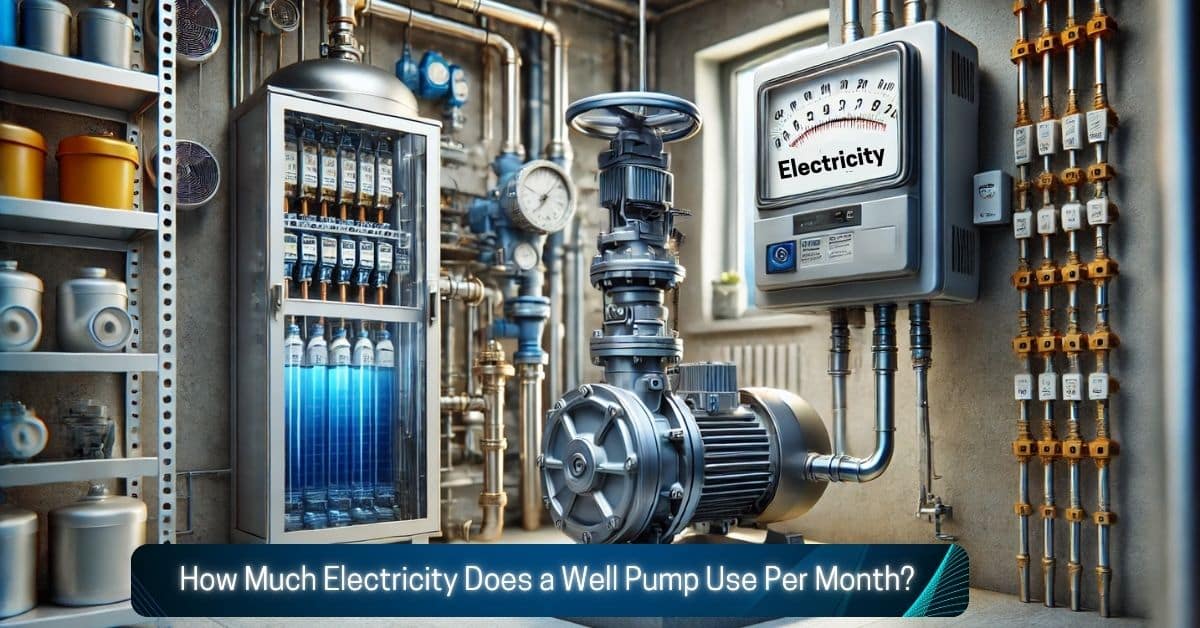
Most homes do not use anywhere near 1,200 kWh per month on a well pump alone. For a typical residential well pump, monthly use is usually in the tens to low hundreds of kilowatt-hours, not the thousands. Using the U.S. Energy Information Administration’s kWh formula, a pump drawing roughly 0.75 to 1.4 kW and running 1 to 4 hours per day works out to about 23 to 168 kWh per month (estimate) (EIA).
Monthly consumption changes with pump size, well depth, pressure settings, and household water demand. Reviewing those variables gives homeowners a more realistic way to estimate operating cost and spot avoidable waste.
This guide explains how to estimate well-pump electricity use, what changes the number, and which upgrades or maintenance steps can reduce unnecessary runtime.
Understanding Well Pumps
Knowing the pump type, key components, and proper sizing helps explain why one home may use far more electricity than another.
Types of Well Pumps
Most residential systems use either a submersible pump or a jet pump.
- Submersible Pumps: These sit below water level and push water to the house. They are the standard choice for deeper wells and usually deliver stronger performance at greater depths.
- Jet Pumps: These sit above ground and pull water with suction. They are generally used for shallow wells and are easier to access for service.
Choosing the right pump type depends on the depth of your well and your water needs.
Key Components of a Well Pump
A well pump has several components that affect both performance and electricity use.
- Motor: The motor drives the pump. Matching motor size to the well and household demand helps avoid wasted electricity.
- Impeller: The impeller is responsible for moving the water. Its design affects how much water you can pump and how efficiently.
- Control Box: This manages motor starting and protection on many systems.
Knowing these parts makes it easier to understand why a pump may short-cycle, run too long, or draw more power than expected.
Determining Pump Size and Horsepower
Choosing the right pump size and horsepower helps control both water performance and operating cost.
Start with household demand. Measure the flow rate in gallons per minute (GPM) needed for showers, appliances, irrigation, or outdoor taps.
Then match that demand to the appropriate horsepower. Deeper wells and higher pressure requirements often need more motor capacity.
Here’s a quick reference:
- 1/2 HP: Good for shallow wells or small households.
- 3/4 HP: Suitable for standard households with moderate demands.
- 1 HP: Necessary for larger homes or high-demand situations.
Correct sizing reduces unnecessary runtime and helps prevent avoidable wear.
Electricity Use by Well Pumps
Understanding how much electricity a well pump uses helps homeowners manage energy costs. The main drivers are pump wattage, daily runtime, and how hard the system has to work to deliver water.
Measuring Pump Electricity Consumption
To estimate electricity use, start with the pump’s wattage and the number of hours it runs each day.
The formula is:
[
\text{Electricity Consumption (kWh)} = \left(\frac{\text{Wattage} \times \text{Daily Use Hours}}{1000}\right)
]
Multiply the daily result by 30 for a monthly estimate, then multiply by the local utility rate to estimate cost. The EIA uses the same kWh approach for household electricity calculations.
Average Wattage and Kilowatts
Many residential well pumps draw roughly 750 to 1,400 watts while running (estimate), depending on motor size, lift, and system pressure.
For example, a pump drawing 0.75 kW for 1 hour per day uses about 22.5 kWh per month. The same pump running 4 hours per day uses about 90 kWh per month. A 1.4 kW pump running 4 hours per day uses about 168 kWh per month. These are operating estimates; actual meter readings vary with motor efficiency, pressure settings, and water demand.
That is why a blanket figure such as 1,200 kWh per month is usually unrealistic for a standard residential well pump by itself.
The Role of Voltage and Current
The voltage of a pump affects current draw and wiring requirements. Most residential well pumps operate at 120V or 240V. For the same wattage, a 240V pump draws less current than a 120V pump.
Lower current can reduce strain on wiring and switching components, but monthly kWh still depends mainly on wattage and runtime.
Factors Affecting Energy Consumption
Several operating conditions directly affect how much electricity a well pump uses each month.
Water Demand and Usage
Household water demand has a direct effect on runtime. More showers, laundry, irrigation, livestock watering, or outdoor cleaning usually means the pump starts more often and runs longer.
Estimate demand by looking at the number of occupants, fixture use, irrigation schedules, and any seasonal outdoor watering.
Tracking when the pump runs most often can help identify unusually high use or hidden leaks.
Depth and Yield of the Well
Well depth also matters. A deeper lift generally requires more work from the pump to move the same amount of water.
A shallow well often requires less lifting energy. Well yield matters too: a well that recovers slowly may force longer pump cycles or stricter water-use management.
In practical terms, two homes with the same pump horsepower can still have different electric use if one system has to lift water farther or maintain higher pressure.
Pump Efficiency and Maintenance
A well-maintained pump usually runs closer to its intended performance. Worn parts, clogged filters, waterlogged pressure tanks, or leaks can force extra cycling and longer runtimes.
An annual service check commonly includes:
- Cleaning Filters
- Checking Seals and Gaskets
- Lubricating Moving Parts
If replacement is already needed, a properly sized newer pump may improve efficiency, but savings depend on the old pump’s condition and runtime.
Pressure Tanks and Pressure Switches
Pressure tanks and pressure switches control how often the pump starts. If the pressure tank is too small or waterlogged, the pump can short-cycle, which increases wear and may increase electricity use.
Pressure settings are commonly in a range such as 30/50 psi or 40/60 psi, depending on the home and equipment. The correct setting should match the tank pre-charge and the system design.
A properly sized tank stores water between pump cycles and can reduce unnecessary starts.
Energy Efficiency and Cost-Saving Strategies
Several upgrades and operating changes can reduce well-pump runtime or improve how efficiently the system delivers water.
Upgrading to Energy-Efficient Models
Replacing an oversized or failing pump with a properly sized model can reduce unnecessary electricity use.
Look for manufacturer performance data that matches the home’s required flow rate, lift, and pressure. Proper sizing matters more than marketing claims alone.
A replacement makes the most sense when the existing pump is worn, improperly sized, or already due for service.
Using Variable Speed Pumps
A variable speed pump can improve comfort and reduce some inefficiencies because it adjusts output to match changing demand instead of running at one fixed speed.
That can help in homes with fluctuating demand or where pressure consistency is important.
Energy savings vary by system design and water use, so they should be treated as site-specific estimates rather than guaranteed results.
Incorporating Renewable Energy
Adding renewable energy such as solar can offset some of the electricity used by a well pump, but the economics depend on local rates, equipment cost, and available sun exposure.
Solar-backed systems can help with operating cost or backup planning, but they still need correct pump sizing, controls, and storage design.
For most homeowners, reducing leaks, fixing short-cycling, and estimating runtime accurately will have a more immediate effect than adding generation equipment.
Frequently Asked Questions
These are common questions about well pumps and monthly electricity use.
What’s the daily power usage of a well pump?
Daily usage depends on wattage and runtime. For example, a 1,400-watt pump running continuously for 24 hours would use 33.6 kWh in one day, but that is a worst-case math example rather than normal household operation.
Can a well pump be a major player in your electric bill?
A well pump can be a noticeable line item on an electric bill, especially with long runtimes, deep wells, irrigation demand, or a system problem that causes frequent cycling. The actual cost depends on monthly kWh use and the local utility rate.
What’s the wattage for a typical 1/2 horsepower well pump?
A 1/2 horsepower pump is often in the neighborhood of 500 to 750 watts while running (estimate), but the exact draw depends on motor efficiency, pump design, and load.
How can you calculate the power consumption of your pond pump?
Use the same formula: (pump wattage x hours of use per day) / 1000 = daily kWh. Multiply by 30 for monthly kWh, then multiply by the local electric rate for monthly cost.
Is it all right to keep a well pump running non-stop?
Continuous operation is usually a warning sign. It can overheat equipment, increase wear, and may point to a leak, a pressure-tank problem, or unusually high water demand.
How many hours a day should your well pump be operational?
There is no single correct daily runtime. Many homes may only need intermittent pump operation spread through the day, while larger households or irrigation-heavy properties may run longer. The best benchmark is whether the system meets demand without frequent short-cycling or extended nonstop operation.

Thomas Peterson
Owner WSA
About the Author
Latest Posts
Born and raised in Nanaimo on Vancouver Island. Thomas gained a deep appreciation for the importance of clean, reliable water. With over 15 years of experience working with water treatment systems, Thomas has become a trusted expert in helping local homeowners and businesses resolve the unique challenges of well water across the Island.
From hard water and iron buildup to low water pressure and sediment issues, Thomas takes a practical, no-nonsense approach to solving water problems. Whether it’s installing filtration systems or troubleshooting well pump issues, Thomas focuses on long-lasting solutions that help people get the clean, safe water they need.
As a proud local professional, Thomas is dedicated to serving his community with honesty, quality service, and expert advice tailored to the water conditions of Vancouver Island.
Areas of Expertise: Well Service, Well Pumps, Water Filtration Systems
- Clack Water Softener Alternatives: Top Systems for Hard Water Treatment in 2025 November 8, 2025
- Best Well Water Test Kit Options for Safe Home Water Testing in 2025 November 5, 2025
- Best Well Water TDS Meter for Accurate Home Testing in 2025 November 1, 2025
- Best Well Water Sediment Filter Systems for Clean Home Water in 2025 October 29, 2025
- Best Well Water Saltless Water Softener Systems for 2025 October 26, 2025
Facebook Twitter LinkedIn Instagram Reddit
Fact Checked & Editorial Guidelines
Our Fact Checking Process
This publication prioritizes accuracy and integrity in its content. Here is how those standards are maintained:
- Expert Review: All articles are reviewed by subject matter experts.
- Source Validation: Information is backed by credible, up-to-date sources.
- Transparency: References are cited clearly and potential conflicts are disclosed.
Learn more about the fact checking process and editorial policy.
Reviewed by: Subject Matter Experts
Our Review Board
Content is reviewed by experienced professionals for accuracy and relevance.
- Qualified Experts: Each article is assessed by specialists with field-specific knowledge.
- Up-to-date Insights: The latest research, trends, and standards are incorporated.
- Commitment to Quality: Reviewers check clarity, correctness, and completeness.
Look for the expert-reviewed label to read content you can trust.